Thursday, July 31, 2025

ZZ25004 Cloud Computing Growth V01 010825

 Tech giants’ dominance of cloud industry ‘damaging competition’


James Hurley 

The dominance of Microsoft and Amazon over the cloud computing industry is damaging competition, a regulatory panel has concluded.

The Competition and Markets Authority said that the American technology companies’ impact on the cloud market was exacerbated by factors such as barriers to customers switching away from their services. Microsoft was also singled out because of licensing terms that the panel said adversely affected Amazon Web Services and Google.

The regulator said that it would consider next year whether to give Amazon and Microsoft so-called “strategic market status”, which would give it additional powers to intervene to boost competition.

An independent panel of the authority found that the cloud services market was “not working well” and that Microsoft and Amazon Web Services each had a market share of between 30 and 40 per cent in areas such as online information processing, storage and networking. Google has a share of between 5 and 10 per cent.

The CMA said in January that Microsoft was using its dominance in enterprise software, such as Windows Server and Microsoft 365, to limit competition by charging high licensing fees when its services were used on rival cloud platforms to its own.

Cloud computing is the term for services such as storage, software, processing and analytics provided over the internet. This provides access to shared computing resources on demand so that customers do not need to own the underlying hardware and software.

UK customers spent £10.5 billion on cloud services in 2024, and spending has grown by nearly 30 per cent each year since 2020 as people and organisations rely increasingly on cloud rather than on-premises or “traditional” IT.

The CMA said it was “vital that competition works well in these markets to support innovation, investment and improved productivity”.

The industry has been scrutinised by regulators on both sides of the Atlantic.

In Europe, Microsoft agreed a €20 million deal last year to settle a complaint about its licensing practices, averting an investigation and a potential fine.

On Wednesday Microsoft said that strong business demand for artificial intelligence tools in its Azure cloudcomputing unit had led to quarterly earnings much better than forecast.

The CMA found Amazon and Microsoft “hold significant unilateral market power in the cloud services markets’’ allowing them to “earn returns above the cost of their capital over a sustained period” and that these “levels of concentration are likely to endure”.

“It is harder for alternative cloud suppliers to enter and grow in these markets and customers face a limited choice of suppliers and products,” it said. “This harm is exacerbated by the features arising from technical and commercial barriers to switching.”

Customers find themselves locked into an initial choice of provider “which may not reflect their evolving needs and limits their ability to exercise choice of cloud provider”.

Microsoft said: “The panel’s most recent publication misses the mark again . . . Its recommendations fail to cover Google, one of the fastest-growing cloud market participants.”

Amazon said that “clear evidence of robust competition” had been disregarded.

“The action proposed is unwarranted and undermines the substantial investment and innovation that have already benefited hundreds of thousands of UK businesses,” it said.

Saturday, July 26, 2025

ZZ25003 Meta and it’s AI Investment V01 270725

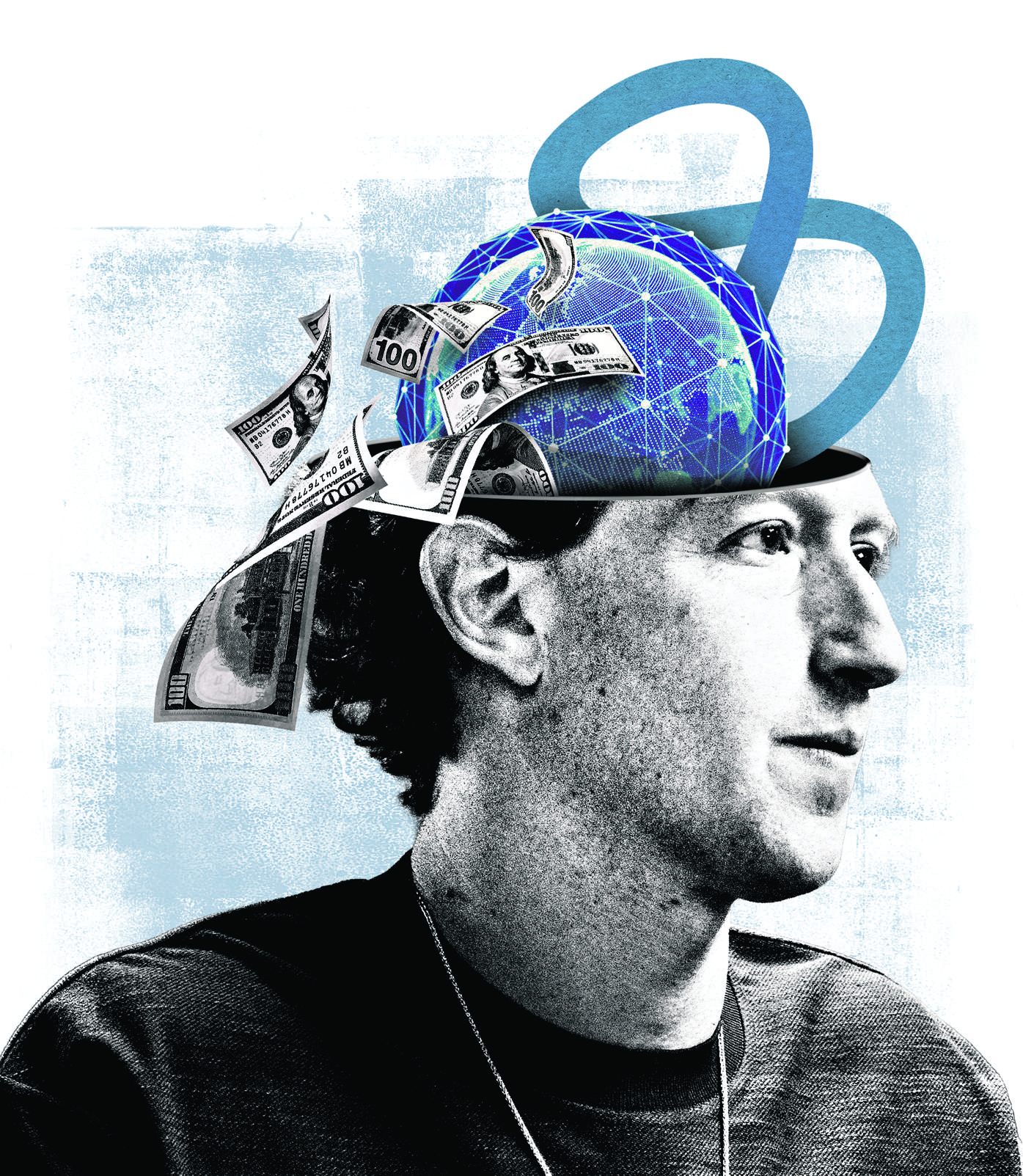
On July 4, Mark Zuckerberg donned a head-to-toe bald eagle costume and hopped on a hoverboard that sliced through the deep blue waters of Lake Tahoe at very high speed. “Is this the stupidest thing we’ve done so far?” he is heard to say through the costume.

It may not be.

Ten days after his Independence Day stunt in California, the Meta billionaire took to his social media app, Threads, to announce a scorched-earth scheme to dominate artificial intelligence. His plan, he said, was to invest “hundreds of billions of dollars” in AI infrastructure — data centres. A single site, Hyperion, could be nearly as large as the island of Manhattan and require 5GW of power — enough juice to power five million British homes.

For context, Britain’s newly opened Isambard-AI “supercomputer” at Bristol University is 5MW — a thousandth of the size of Zuck’s planned mega-site.

The Facebook founder’s posts were part recruiting effort for his new unit, called Meta Superintelligence Labs, and part scare tactic.

“Meta Superintelligence Labs will have industry-leading levels of compute and by far the greatest compute per researcher. I’m looking forward to working with the top researchers to advance the frontier,” he said. “We have the capital to do this.”

Put another way: we are going to turn all of our social media cash into an AI leviathan with which virtually no one can compete. His shot across the bow of rivals came amid reports that he was personally emailing top AI coders with offers ranging from a few million to, ahem, $1.25 billion (£930 million), to lure them from rivals such as OpenAI, Google and Apple. And it has worked.

The 41-year-old, whose company will report its second-quarter results on Wednesday, has with blinding speed assembled a team of top AI talent. They include Alexandr Wang, former chief executive of Scale AI; Nat Friedman, former boss of the software development platform GitHub; Daniel Gross, ex-chief of AI company Safe Superintelligence; and Ruoming Pang, a former AI executive at Apple (and recipient of a reported $200 million pay packet).

Andrew Bosworth, Meta’s technology chief, said last month: “The market is setting a rate here for a level of talent which is really incredible and kind of unprecedented in my 20-year career as a technology executive.”

All of which leads to two questions: what is Zuck’s goal, and will his wall of money get him there? His new “north star” appears to be creating “personal superintelligence”— machines smarter than any human. What that means for Meta as a business, or for the average person, is vague. In a recent internal memo announcing the artificial intelligence lab, he said: “As the pace of AI progress accelerates, developing superintelligence is coming into sight. I believe this will be the beginning of a new era for humanity, and I am fully committed to doing what it takes for Meta to lead the way.”

A new era for humanity? If he’s right, then perhaps it makes sense to offer a single coder $1.25 billion over four years, as rumoured by Daniel Francis, founder of Abel, a developer of AI for police forces.

“Was informed of a $1.25 billion offer for four years,” Francis tweeted last week.

“New highest I’ve seen. Guys, what the hell is going on?”

Meta declined to comment, though one gets the sense that Zuck rather likes this type of publicity.

His creation of a shiny new division with a lofty goal is canny. The best people want to work on the most ambitious projects; a species-altering tech advance ticks that box. And Zuck drove home the point that he has what most of his competitors don’t: a core business that means he can self-fund his grand project.

Rivals such as OpenAI, Elon Musk’s Grok chatbot and Anthropic, maker of the Claude chatbot, are losing vast sums of money. They exist entirely at the pleasure of their investors. If this is a knife fight, Zuckerberg has just shown up with a bazooka on his shoulder.

The only company in the consumer AI race who can match Zuck’s bucks is Google. That said, money alone is not enough.

"You’ll struggle to find someone who really believes in our AI mission

Tijmen Blankevoort, a former member of Meta’s 2,000-strong AI team, recently published a blistering post on an internal message board on his way out of the company.

The missive, first reported by tech publication The Information, slammed Meta’s “culture of fear”, which has spread through the company like a “metastatic cancer”. He added: “You’ll be hard pressed to find someone that really believes in our AI mission. To most, it’s not even clear what our mission is.”

His screed appeared to be borne of frustration at the development pace and lacklustre performance of Llama, Meta’s flagship AI model. And Zuckerberg, clearly, shared those views, which sent him on his spending spree.

Blankevoort’s post came before the flurry of recruits and creation of the new lab.

If Zuck’s gambit works, there are innumerable ways in which AI could alter how Meta operates as a business. For one, Zuckerberg predicted earlier this year that 2025 will be the year that AI will approximate a “good, mid-level engineer”.

For an employer of 77,000 humans, that could lead to marked productivity improvements, and potentially slow hiring or job cuts. Microsoft’s Satya Nadella has shown the way: he has pushed through 15,000 redundancies amid record-setting financial performance.

And then there is the advertising industry, which the Meta boss hopes to, in effect, completely destroy. In a recent interview with tech blog Stratechery, he laid out his vision to automate the entire advertising process — from the creation of ads themselves, to targeting, delivery and monetisation.

“We’re going to get to a point where you’re a business, you come to us, you tell us what your objective is, you connect to your bank account,” he said. “You don’t need any creative, you don’t need any targeting demographic, you don’t need any measurement, except to be able to read the results that we spit out.

“I think that’s going to be huge. I think it is a redefinition of the category of advertising.”

The last leg of the stool is Meta’s 3.4 billion users. Zuckerberg likes to brag that his company, owner of Instagram, Facebook, WhatsApp and Threads, is the only one in the world whose AI is being used by more than a billion people.

This is technically true: Meta has jammed its AI button into the middle of all its apps.

But really, this comes down to a question of invention and, more pointedly, taste.

Can Zuck turn all of that expensively acquired brain power into products people want? In answer to that question, I offer an exhibit: the metaverse.

Remember that? Cast your mind back to 2021. Zuckerberg laid out a bold vision for a techno-utopian dreamland where we would don virtual-reality goggles and show up as legless cartoon avatars in virtual meeting rooms full of legless colleagues to go over the latest quarterly numbers.

So excited was he by this fantasy that he renamed his company. In the past four years, the Reality Labs division — the unit responsible for delivering that vision — has lost $56 billion. And we are no closer to that particular fever dream.

In Zuck’s favour this time is that AI is, already, showing itself to be useful and hugely popular — if also terrifying.

Unlike with the metaverse — an invention no one asked for, nor wanted — the demand for AI is vast and growing. But does Zuck have the taste to create a product people want? There are some things that money can’t buy.

$1.25bn Reportedly on offer to lure top AI coders

Tuesday, July 22, 2025

ZZ25002 AI Computer Code Generator V01 220725


The Rundown: Only eight months after writing its first line of code, Swedish vibe coding platform Lovable has grabbed a mammoth $200M Series A, slingshotting it to a $1.8B valuation and making it Europe’s buzziest new unicorn.

The details:

  • Lovable has already scaled to 2.3M active users, making it one of Europe’s fastest-growing AI startups.

  • The company lets users with no coding skills create full-fledged websites and apps simply by describing them in natural language prompts.

  • While millions use Lovable for free, 180K users pay for advanced features, bringing in $75M in annual recurring revenue after just seven months.

  • Now, it plans to double down on hiring world-class talent, expand its AI capabilities, and launch partnerships to integrate more deeply with toolchains.

Why it matters: In a category with fierce contenders like Cursor and Replit, Lovable’s $200M Series A — Europe’s largest ever for an AI coding startup — is remarkable not just for its scale but for how quickly the company achieved a $1.8B valuation — less than a year after launching its platform and with just 45 employees.

Sunday, July 13, 2025

ZZ25001 AI V01 130725

Is the AI bubble About to burst?
AI mania has gripped Silicon Valley. Firms are offering vast sums to lure workers while start-ups with no products bag huge valuations. For our correspondent, memories of the dotcom crash loom large

DANNY FORTSON - IN SAN FRANCISCO

Mira Murati’s Thinking Machines Lab is $10 billion — neither has product or revenue

I returned to work last week after a brief sabbatical and Silicon Valley, in my absence, has truly lost its mind. Tales of $100 million — even $200 million — pay packages for software developers ricochet through the Valley as AI-induced mania scales new heights. The value of chip giant Nvidia has just crossed the $4 trillion threshold, a 12-fold increase in 30 months that has turned an estimated 80 per cent of its workforce into millionaires.

And then, of course, there are the start-ups. Thinking Machines Lab, a company started by Mira Murati, a co-founder of OpenAI, a mere five months ago, has raised $2 billion in funding at a valuation of $10 billion (£7.5 billion). This company has neither product nor revenue. What it does have is a collection of big brains who once worked at OpenAI. That, apparently, is enough.

Ilya Sutskever, another OpenAI refugee, reeled in $2 billion for his company, Safe Superintelligence at, checks notes, a $32 billion valuation! It has yet to trouble the world with a product.

History does not repeat itself, as the trope goes, but it rhymes. Which is why the madness to which I have returned takes me back to December 1999, when I graduated with a liberal arts degree and a surfeit of energetic naivety.

The internet boom was in full bloom and so I hatched a cunning, three-stage scheme: move to San Francisco, get a job at a dotcom (any would do), and watch my share options explode in value, turning me into a millionaire by the age of 25.

You’ll be surprised to learn that my watertight plan sprung a few leaks. I did move to San Francisco, and I did land a job at a buzzy dotcom that was so desperate for warm bodies, it looked past the rather underwhelming skills implied by my degree in international relations and Spanish.

I lasted four months. The dotcom bubble burst, my employer realised it had no chance of ever raising money again, and deemed me — and much of the company — surplus to requirements. It went under not long after, with thousands of others.

The experience was, in retrospect, a fabulous internship for the business reporter I would become. Seasoned business leaders, top bankers, the world’s savviest investors ... they had all drunk the Kool-Aid. Otherwise intelligent and canny operators had been swept up in a type of group hysteria, fuelled by a powerful cocktail of optimism, magical thinking and greed. Who needs profits when we are about to change the world? Sound familiar? So is this time “different”, as anyone with a PowerPoint deck and an AI idea to sell would have you believe? I think two things are true. AI will, indeed, change just about every industry and how we live, in ways large and small. Yet it is also true that we are in the midst of a gigantic bubble that, when it pops, will lead to the disappearance of most AI companies and wipe out trillions of dollars of wealth in private and public markets.

The latter, after all, is not a big leap.

Since the start of 2023 to last month, the “Magnificent 7” tech stocks, Apple, Microsoft, Alphabet, Meta, Nvidia, Amazon and Tesla, have gained $9.7 trillion in market value.

This bears repeating: that figure is the combined value increase, not the overall sum. Put another way, the rise in value of those seven companies over these past two and a half years is equivalent to recreating the entire listed universe of 2,000 companies on the London Stock Exchange — twice. Downstream of those astronomical figures is the bubbling cauldron of Silicon Valley start-ups, which are taking advantage of the mania to raise eyewatering amounts of money at valuations that most have no hope of earning their way into.

Indeed, last year alone, Californian start-ups raised nearly $50 billion across more than 850 financing deals, according to data from PitchBook.

The upshot is that money is sloshing around to a degree not seen since the internet turned the world upside down.

And amid the madness, the biggest beneficiaries are, without question, software nerds.

The top keyboard jockeys are being courted with pay packages to rival Premier League footballers. OpenAI’s Sam Altman made headlines recently when he said Meta’s Mark Zuckerberg was offering $100 million bonuses to lure away his top talent. Andrew Bosworth, Meta’s chief technology officer, poured cold water on the claim — sort of. “Sam is just being dishonest here,” he reportedly told an internal meeting. “He’s suggesting that we’re doing this for every single person … Look, you guys, the market’s hot. It’s not that hot.”

So, not every single person, but some? Indeed, just look at what Meta has done in the past month. It paid $14.3 billion for 49 per cent of Scale AI, effectively “acqu-hiring” the engineers at a start-up that labels training data for AI model developers.

Under the deal, 28-year-old founder Alexandr Wang joined Meta’s “SuperIntelligence Labs”. Zuck’s bags of cash have lured a handful of senior OpenAI coders to the new unit. He also poached Daniel Gross, the 34-year-old chief executive of SSI, Sutskever’s start-up, as well as Nat Friedman, the 47-year-old former chief of Github. Gross and Friedman ran an investment fund together, and it is understood that Meta bought out their stake for about $1 billion to bring them into the fold.

Just days after Bosworth’s lukewarm denial, reports emerged of an even richer deal. Ruoming Pang, Apple’s former head of AI models, was said to have joined after Zuckerberg offered him a multi-year deal worth $200 million.

One can understand why so many engineers are happily taking Zuck’s money. The Silicon Valley machine is, by design, messy and unpredictable.

OpenAI, for example, has jumped from a $1 billion valuation in 2019 to $300 billion today.

"$100m sign-on bonues for staff to join Meta? Look, you guys, the market’s hot ... it’s not that hot!

Anthropic, maker of the Claude chatbot, was founded just four years ago and its valuation has already soared to $60 billion.

Sales, meanwhile, are on track to top $4 billion over the 12 months — from a standing start in 2022. OpenAI has forecast $13 billion in revenue for 2025, all from a suite of products that did not exist three years ago.

The mind boggles. And yet soaring growth today does not guarantee success tomorrow. Remember when Yahoo was the master of all it surveyed? Remember when MySpace dominated social media? For every ten companies that get venture capital backing, roughly five will die, four will limp on, merge or get bought for a modest sum, and one, if its investors are lucky, will turn into a properly successful company. Perhaps it becomes a unicorn — until it is disrupted by the next white-hot start-up. The sands are always shifting, so when offered life-changing, generational wealth, many are taking it.

And yes, Zuck has spent $15 billionplus in a matter of weeks for a battalion of sun-starved coders but old hands see his moves as utterly logical. Because if indeed AI is the generational technology that Silicon Valley believes it is, those who grab control of it stand to make hundreds of billions, even trillions, as it replaces humans and takes over more and more of the economically valuable work.

Reid Hoffman, the billionaire LinkedIn founder and early Meta investor, said last week: “The talent race, to your average American, looks crazy — the amount of money you’re paying individuals in order to do this.”

But he added: “If you invent the thing that essentially — for example, my own start-up, Manas AI, is trying to cure cancer — transforms industries, and if you think this individual is the one to do it, then it begins to get more economically rational.”

There is, of course, another option — that AI sets off a more gradual and messy transformation, much like the internet just before the dotcom blowout, when most companies crashed and burnt but a few start-ups emerged from the chaos.

That appears to be the view of Peter Thiel, another billionaire techie.

“My placeholder is that it’s roughly on the scale of the internet in the late Nineties,” he said recently. “It might be enough to create some great companies.

And the internet added maybe a few percentage points to gross domestic product, maybe 1 per cent to GDP growth every year for ten, 15 years. It added some to productivity. That’s roughly my placeholder for AI.”

So, no revenue. No product. No problem. Until, of course, it is.

$9.7trn The gain in value of the top seven companies over two and a half years