RASPBERRY PI
Market cap £803 million
Half-year revenue $135m
Raspberry Pi expects to sell more of its own semiconductors than its famous little computers for the first time this year. Designed in the UK and manufactured in Taiwan, these “microcontrollers” do not make as much money per unit as the company’s computers, but their mix of high performance and low price has turned them into a hit.
In its latest interim results, Raspberry Pi revealed that it had shipped 4.5 million chips in the first half of this year, more than double the year before. Eben Upton, the cofounder, said: “We are quite enjoying being a semiconductor business!”
Perhaps there could be a future opportunity with Arm, the giant semiconductor designer and a fellow Cambridge company, which holds 6 per cent of the equity? This striking sales inflection point reflects the size and diversity of the firm’s offering and customer base. To some this shows a lack of focus, but others feel it demonstrates versatility.
In a note published immediately after its numbers, Jefferies, the brokerage, called it “unique among single-board computer suppliers in its expertise across semiconductors and software in addition to hardware design”, arguing this “broad strength” would help to increase profitability and market share.
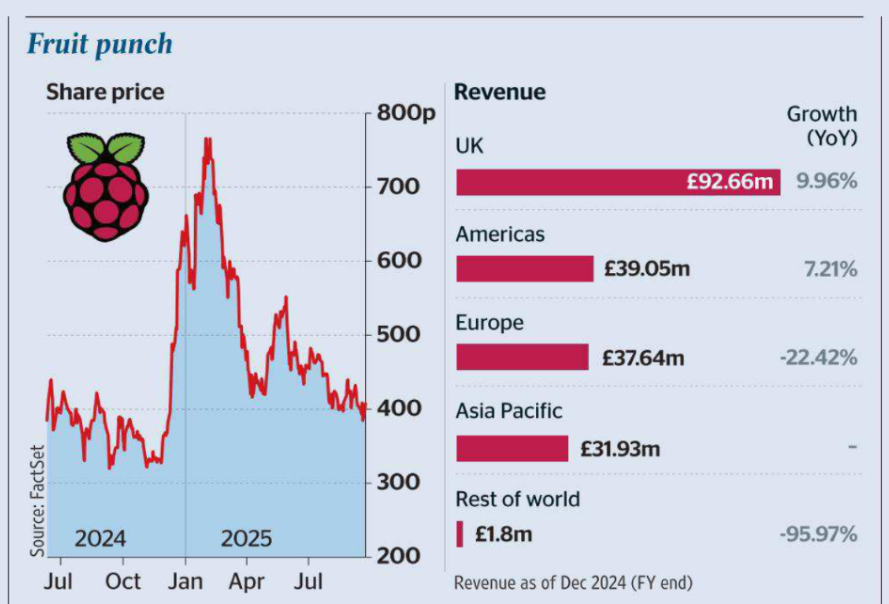
It has not been an easy ride since the company floated last June. The share price has fallen 7 per cent after an impressive rally since its IPO last year, a sign that investors sometimes struggle to know what to make of it.
Some criticise the 25 per cent profit margin as too small and wonder if it can live up to the hype. Sentiment has also been hit by nerves around any potential fallout from President Trump’s sweeping global tariffs. The shares currently trade at 35 times forecast earnings, a discount to a multiple of 42 in May.
The business is best known for making credit card-sized, low-cost computers originally designed for teaching coding, but now used for everything from DIY electronics to robotics. Almost a third are sold to hobbyists but the bulk are used by industry and this is the direction of travel for the business, which is growing its reseller pipeline.
A significant share of sales now depend on a small number of big customers. One major component distributor provided 24 per cent of revenue, $32.4 million, in the first half of 2025; a contract manufacturer accounted for another 4 per cent.
The firm has finally shrugged off uneven demand from customers and Covid disruption to supply chains. It is set to meet full-year expectations.
For the six months to the end of June, overall sales were down by 6 per cent to £135.5 million, due to weaker royalties and component sales, against the backdrop of an extremely strong period last year. But unit sales were up 9 per cent from the second half.
It saw a 43 per cent drop in pre-tax profit in the first half, to £6.2 million from £10.8 million, partly because of costs related to the company’s staff equity scheme. It seems to have resolved its longstanding inventory issue, where customers had built up stock, so paused new orders while working through it.
The company has seen a return of demand from China, buoyed by, Upton said, enterprising engineers who are “less conservative” than their western peers.
With exports, the company claims to have dodged any tariff impact, partly because its computers are built in Mid-Glamorgan and incur 10 per cent tariffs, lower than some peers.
Upton also sees this as a huge advantage at a time when tensions with China are increasing.
But while geopolitics grab the headlines, the real issue is the cost of memory chips, which in some cases have risen about 120 per cent in the past two years. The company has stockpiled enough to cover this year and is working on back-up supply options for next year, but it has not ruled out future price rises.
Looking ahead, there are more product launches scheduled this year including a new AI add-on that can run chatbots. Strikingly, Raspberry Pi might be the only tech company in the world not touting the magic powers of AI. It was only mentioned on one of its results slides.
This does not mean it is ignored. Upton, a former Cambridge don, shrugs that “of course” its products are used for AI, but remarks: “AI is just adding things up.”
ADVICE Hold
WHY Semiconductor growth could spur a fresh rally

.png)
.png)
.png)
.png)