How Starlink is rewiring the planet
When Alex Leiserach and his wife moved from West Sussex to a farmhouse in the Lincolnshire countryside, they knew it would be a big life change. What they did not expect was to travel back in time to when web connections were so slow that pages would appear to download pixel by pixel. “It was like dial-up internet,” said the 42-year-old. “If my wife and I both wanted to send an email, one of us would have to wait.”
A promised fibre connection under Project Gigabit — the government’s £5 billion plan, launched in April 2021, to connect 99 per cent of British households to broadband internet — was years away, so instead Leiserach joined the customer ranks of Starlink, the space-based internet business of Elon Musk’s $350 billion (£270 billion) rocket company SpaceX.
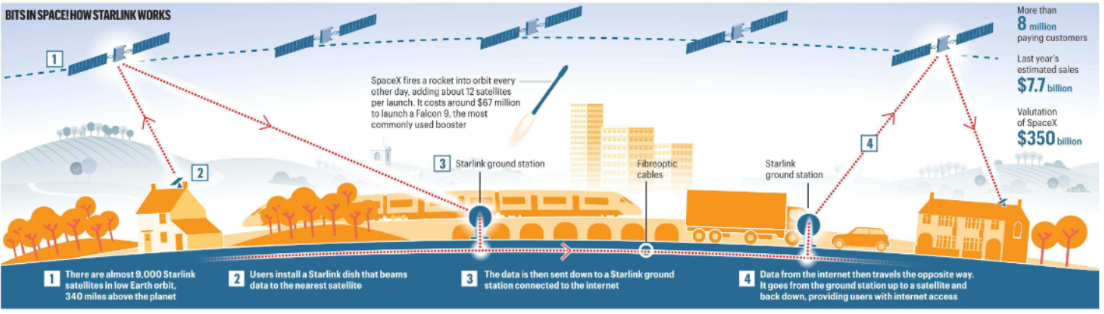
For £75 per month (and £299 for the dish), he gets enough bandwidth beamed from satellites orbiting 340 miles above the Earth’s surface to run The Layby Lincs, the glamping business he and his wife have set up on their property.
“There could potentially be our five units in the garden, plus us, streaming video at the same time — and we’ve never noticed anything buffer,” he said.
Tales like this illuminate one of the most extraordinary business stories unfolding in the world today. With Starlink, Musk is rapidly building a new layer of global infrastructure that offers an alternative to the messy traditional approach: digging up roads and laying thousands of miles of fibreoptic cable.
Instead, through SpaceX he has launched nearly 9,000 internet-beaming satellites into orbit, which have opened up the prospect of bringing online the 2 billion-plus people globally who, the World Economic Forum estimates, are still without internet access.
Starlink this month hit 8 million paying customers, from the 2.3 million it had at the start of 2024. Sales last year leapt to an estimated $7.7 billion, surpassing the fees paid by governments and companies to hitch a ride on SpaceX rockets. And as its launch cadence grows — SpaceX now fires a rocket into orbit roughly every other day — so too does Starlink’s constellation.
SpaceX adds about 12 satellites per launch, filling out a network that provides internet access almost anywhere — from the turrets of medieval castles in England to deep-sea fishing vessels in the North Pacific to, as of next year, the entire fleet of British Airways passenger jets.
Jonathan McDonnell, an astronomer at the Harvard-Smithsonian Center for Astrophysics in Massachusetts, said: “Starlink is starting to deliver on [Musk’s] promise of ubiquitous broadband internet for everyone.”
Steve Durkin, founder of Rutland Broadband, installs Starlink for farmers and other customers who have been waiting years for the rural broadband initiatives promised by successive governments.
Ofcom, the UK industry regulator, estimates that 3 per cent of Britons over the age of 16 — 1.3 million people — do not have internet access.
Durkin said: “The rural community absolutely needs the internet. Pretty much every piece of farm equipment these days is connected, and they run sophisticated agronomy systems, field analysis and all the science behind optimising crops. There’s no good alternative ... Starlink has been a game-changer.”
The idea for Starlink began in the mind of Elon Musk. Obsessed with making humans “interplanetary” by colonising Mars, he recycled $100 million he made from the sale of PayPal to eBay in 2002 to design, from scratch, a reusable rocket that could theoretically be orders of magnitude cheaper than other rocket systems in use at the time.
It was, on the face of it, an insane idea.
Governments, not private companies, built rockets — and certainly not companies run by someone with zero experience in spaceflight. “We started off with just a few people who really didn’t know how to make rockets,” Musk once said of the early days of SpaceX.
Its first three rockets failed, pushing the company to the edge of bankruptcy.
“Fortunately, the fourth launch — the last money we had for Falcon 1 — worked. Or that would have been it for SpaceX.”
Today, the Falcon 9 — the ninth iteration of that first rocket — is the workhorse of the fleet. Every two and a half days, one of them blasts off from Florida or California ferrying all manner of hardware to space, from satellites and GPS kit to supplies for Nasa’s International Space Station.
The breakthrough was making the booster reusable. Before SpaceX, rockets were artisanal. Each booster would deliver a single payload to orbit then detach, crash into the ocean and never be seen again. The ability to not just control a descent, but direct the rocket to land with pinpoint accuracy, was deemed simply too hard.
But SpaceX, after many misfires, has mastered the technology. The upshot is that it has brought down launch costs by a factor of ten, allowing it to grab most of the market, while also spawning a generation of start-ups whose business models are enabled by the suddenly cheap cost of getting their equipment into orbit.
The other reason for satellite internet’s boom is the level of orbit. Previous providers operated from 22,000 miles above the Earth, resulting in lags that limited their utility. Signals from Starlink in “low Earth orbit” of about 340 miles have far shorter distances to travel, resulting in speeds akin to terrestrial internet.
Adecade ago, about 1,200 working satellites orbited the Earth; today there are 12,000, most of which are Musk’s. If the 54-year-old billionaire and his rivals, including Amazon Leo, the online retailer’s nascent satellite internet service, deliver on their plans, there could be more than 100,000 satellites circling the globe by 2035.
The implications could be profound.
The last dark corners of the planet would be lit up — but it would also concentrate even more power in the hands of the world’s richest man.
A fault in September briefly cut service across the network — from the front line of the Russia-Ukraine war, where Kyiv’s military relies on Starlink, to Leiserach’s Lincolnshire business — highlighting what a critical lever Starlink has become on the world stage.
The amount of kit being put into orbit also increases the risk of catastrophe. Satellites circle the globe at 17,000 miles per hour. A collision could set off a chain reaction that sends shrapnel hurtling through space, destroying other satellites and rendering swathes of orbit unusable.
This could affect everything from bank transactions to climate-change monitoring.
As McDonnell puts it, “The Earth economy is now strongly entangled with the space economy.”
SpaceX and its rivals regularly “deorbit” satellites, lowering them at the end of their useful life to be incinerated by the atmosphere. “We could see 20 satellites re-entering a day, and each of these satellites is like half a tonne,” McDonnell said.
“So you’re adding many tonnes of metal a day, in multiple forms, to the upper atmosphere. We know that will have an effect on atmospheric chemistry.”
For most, however, the ability to tap into high-speed internet outweighs such concerns. When Simon Burton, 66, a retired tech worker, moved to the West Country village of Kingsdown, he tested the speed of the existing service. It was bad: 21 megabits per second (Mbps).
BT Openreach said there were no plans to lay fibre for at least 12 months.
“I’ve been a BT customer all my life, so I have massive loyalty. But the obvious answer was Starlink,” he said.
Yet even the service’s most loyal customers are wary of being so reliant on Musk, whose behaviour has become increasingly erratic in recent years. Leiserach said: “You’re at Starlink’s mercy.
No one likes a monopoly.”
Right now, however, it is the only option he’s got.