China offers a glimpse of its latest jet as confidence replaces stealth
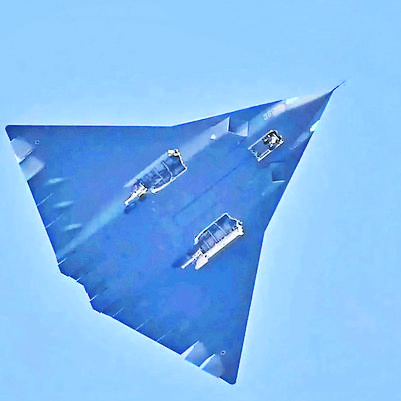
In a scorched and sand-blasted salt lake on the fringes of the Gobi desert barely a month seems to go by without a new building going up and more tarmac being laid. It’s a busy time to be at Lop Nur, China’s secret test base.
Observers of satellite images of the facility, however, were startled by what they saw there in August and September. On one day of each month a supposedly secret stealth jet sat in the afternoon sun at the base in the remotest corner of remote Xinjiang known as China’s equivalent to America’s Area 51.
The delta-winged J-36 and the smaller J-XDS (also known as J-50) are not yet operational but are expected to compete with the best US fighter jets.
Lop Nur has what is thought to be the world’s longest runway, at more than three miles long. Run by the People’s Liberation Army Air Force (PLAAF), it is where it can launch the equivalent of US Air Force “black” (classified) test flights.
The CIA’s U-2 spy plane and the US Air Force’s first stealth fighter, the F-117 Nighthawk, were test-flown at Area 51, for example. In Nevada, notices near the perimeter of Area 51 warn that it is a restricted base and that guards are authorised to use “deadly force” against trespassers. Lop Nur warns simply that anyone trying to steal secrets “will be killed”. Like Area 51, it is prohibited to fly over Lop Nur. But both bases can be photographed by satellites.
Why, then, would the Chinese military have its latest jets out on the tarmac where they can clearly be seen?
Douglas Barrie, an aerospace specialist at the International Institute for Strategic Studies, said: “Leaving these aircraft out in the open means the Chinese don’t mind them being spotted by passing satellites. It’s a way of showing off what they’ve got, even though Lop Nur base could well be described as an Area 51.”
The J-36 and J-XDS are part of what the Pentagon says is China’s ambition to challenge US air power in the Indo- Pacific. The J-36 is believed by US intelligence to have been designed to coordinate drones in a swarming attack, similar in concept to the Pentagon’s Loyal Wingman programme in which drones would fly alongside American F-35 stealth fighters.
Lop Nur is just one of several remote bases where the PLAAF is developing and testing a next-generation fleet of combat fighters, bombers and attack drones. The military parade in Beijing in September included an unmanned stealth fighter — the largest drone on display — although it could have been a mock-up rather than a fully formed aircraft. While China’s most advanced drones under development are being tested at other bases, including Malan in the Xinjiang region, and at a highaltitude testing site at Ngari in Tibet, key flight tests of the J-36 and J-XDS appear to be taking place at Lop Nur.
“But there are plenty of other things which we know they are developing but have never been seen, such as a subsonic, low observable stealth bomber. That’s hidden away,” Barrie said, adding that China now had “military aircraft which are broadly comparable with the US, but the one thing they don’t have is combat experience. The last war they fought was in the 1970s in Vietnam

No comments:
Post a Comment