Tuesday, December 16, 2025

ZZ25066 Wearable AI V01 161225

 Could 2026 be the year ‘life-logging’ wearable AI devices take off?


Katie Prescott

Struggling with what to get the AI-obsessed tech geek in your life for Christmas? I may have the answer: Have you thought about a “life-logger”? If you believe the tech bros, AI’s centre of gravity is moving from screens to our bodies.

With the delightful euphemism, “life-logging,” tech companies are marketing a range of wearable AI devices that record the audio of your entire day, producing summaries, notes or transcripts at the end of it.

Which raises the question: have you lived if you haven’t logged? While buying an “externalmemory” or “second brain” (more excellent marketing terms) could have benefits, they may be offset by the obvious Black-Mirrorish pitfalls.

The most hyped of these products was the $699 Humane AI Pin, founded by ex-Apple designers, which flopped and sold its assets in February to HP. But never fear, there are others and they are fast winning investment from the big guns.

Bee, a company that sells a $50 AI wristband that “turns your moments into meaning” was bought by Amazon in July for an undisclosed sum. Limitless, which makes a $299 AI pendant, was acquired by Meta just a few weeks ago. There is also Plaud, which claims to have 1.5 million users of its £126 recorders and Omi’s $89 big button pendant that you can stick — where else — to your temple.

Could 2026 be the year such wearable AI devices really take off? Limitless co-founder Dan Siroker has claimed: “We’re no longer working on a weird fringe idea.

We’re building a future that now seems inevitable.”

Sam Altman, chief executive of OpenAI, thinks so too. He has partnered with the legendary Apple designer Jony Ive, buying his startup in May for $6.5 billion. Their planned AI product is heavily under wraps, but judging by Altman’s hints, it takes this idea of “life-logging” to the next level.

Altman describes the iPhone as “the crowning achievement of consumer products”, but using it, he says, is stressful. “I feel like I am walking through Times Square in New York and constantly just dealing with all the little indignities along the way: flashing lights in my face, tension going here, people bumping into me.”

Instead, the alternative screenfree device being dreamt up by OpenAI should make us feel like we are “sitting in the most beautiful cabin by a lake and in the mountains and just enjoying the peace and calm ... just letting us focus on other stuff,” Altman mused.

Something which has “incredible contextual awareness of your whole life”.

It reflects a future being widely discussed in tech: “Ambient AI”, something which works in the background of everyday life, listening and interpreting what’s happening without you having to use an app or actively prompt it.

Then, like Santa’s little helper, it takes helpful actions without interrupting the user.

A pen? A pendant? What could this relaxing wearable ChatGPT powered OpenAI thingamabob be? Something for next year’s Christmas list.

If this all sounds a bit woo-woo, Google is launching AI glasses powered by Gemini in 2026. There will be a range with no screen and one with a display on the lenses.

This is its second brave foray into spectacles. Back in 2013 it went over its skis when it launched Google Glass, pulled shortly afterwards on privacy concerns. Life-loggers take note.

Meta is also planning an expansion of its AI glasses at the start of next year and has poached Apple’s designer Alan Dye, in its quest to “bring personal superintelligence to everyone”. It is a lucrative market. HSBC estimates that about 77 million pairs of smart glasses could be sold in 2030, valuing the sector at $36 billion.

In other wearable news, Apple may appear to be lagging behind in the AI race, but the doyenne of tech hardware’s live-translating AirPods are already in the shops.

So, there is lots to look forward to in the wacky wearable AI year ahead. And most obviously, it gives Father Christmas an easy way to monitor our every move and find out who’s on the naughty list.

Katie Prescott is Technology Business Editor of The Times

Sunday, November 23, 2025

ZZ25065 Starlink V01 231125

 How Starlink is rewiring the planet

From UK farms to the front line in Ukraine, Elon Musk connects the world — but what about the space junk, asks Danny Fortson

When Alex Leiserach and his wife moved from West Sussex to a farmhouse in the Lincolnshire countryside, they knew it would be a big life change. What they did not expect was to travel back in time to when web connections were so slow that pages would appear to download pixel by pixel. “It was like dial-up internet,” said the 42-year-old. “If my wife and I both wanted to send an email, one of us would have to wait.”

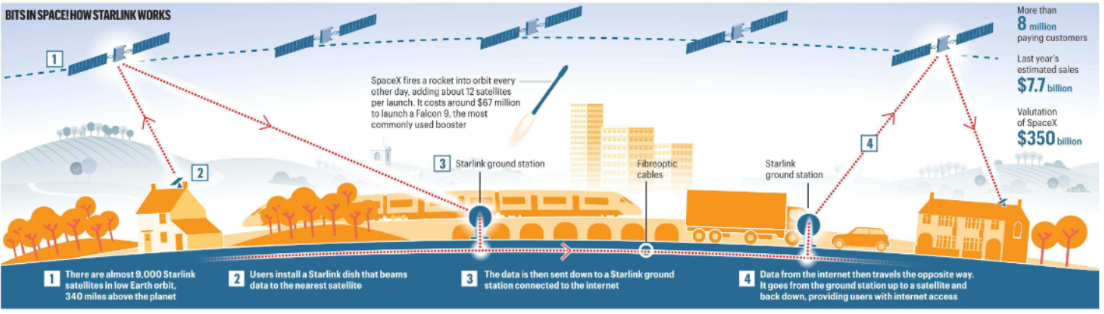
A promised fibre connection under Project Gigabit — the government’s £5 billion plan, launched in April 2021, to connect 99 per cent of British households to broadband internet — was years away, so instead Leiserach joined the customer ranks of Starlink, the space-based internet business of Elon Musk’s $350 billion (£270 billion) rocket company SpaceX.

For £75 per month (and £299 for the dish), he gets enough bandwidth beamed from satellites orbiting 340 miles above the Earth’s surface to run The Layby Lincs, the glamping business he and his wife have set up on their property.

“There could potentially be our five units in the garden, plus us, streaming video at the same time — and we’ve never noticed anything buffer,” he said.

Tales like this illuminate one of the most extraordinary business stories unfolding in the world today. With Starlink, Musk is rapidly building a new layer of global infrastructure that offers an alternative to the messy traditional approach: digging up roads and laying thousands of miles of fibreoptic cable.

Instead, through SpaceX he has launched nearly 9,000 internet-beaming satellites into orbit, which have opened up the prospect of bringing online the 2 billion-plus people globally who, the World Economic Forum estimates, are still without internet access.

Starlink this month hit 8 million paying customers, from the 2.3 million it had at the start of 2024. Sales last year leapt to an estimated $7.7 billion, surpassing the fees paid by governments and companies to hitch a ride on SpaceX rockets. And as its launch cadence grows — SpaceX now fires a rocket into orbit roughly every other day — so too does Starlink’s constellation.

SpaceX adds about 12 satellites per launch, filling out a network that provides internet access almost anywhere — from the turrets of medieval castles in England to deep-sea fishing vessels in the North Pacific to, as of next year, the entire fleet of British Airways passenger jets.

Jonathan McDonnell, an astronomer at the Harvard-Smithsonian Center for Astrophysics in Massachusetts, said: “Starlink is starting to deliver on [Musk’s] promise of ubiquitous broadband internet for everyone.”

Steve Durkin, founder of Rutland Broadband, installs Starlink for farmers and other customers who have been waiting years for the rural broadband initiatives promised by successive governments.

Ofcom, the UK industry regulator, estimates that 3 per cent of Britons over the age of 16 — 1.3 million people — do not have internet access.

Durkin said: “The rural community absolutely needs the internet. Pretty much every piece of farm equipment these days is connected, and they run sophisticated agronomy systems, field analysis and all the science behind optimising crops. There’s no good alternative ... Starlink has been a game-changer.”

The idea for Starlink began in the mind of Elon Musk. Obsessed with making humans “interplanetary” by colonising Mars, he recycled $100 million he made from the sale of PayPal to eBay in 2002 to design, from scratch, a reusable rocket that could theoretically be orders of magnitude cheaper than other rocket systems in use at the time.

It was, on the face of it, an insane idea.

Governments, not private companies, built rockets — and certainly not companies run by someone with zero experience in spaceflight. “We started off with just a few people who really didn’t know how to make rockets,” Musk once said of the early days of SpaceX.

Its first three rockets failed, pushing the company to the edge of bankruptcy.

“Fortunately, the fourth launch — the last money we had for Falcon 1 — worked. Or that would have been it for SpaceX.”

Today, the Falcon 9 — the ninth iteration of that first rocket — is the workhorse of the fleet. Every two and a half days, one of them blasts off from Florida or California ferrying all manner of hardware to space, from satellites and GPS kit to supplies for Nasa’s International Space Station.

The breakthrough was making the booster reusable. Before SpaceX, rockets were artisanal. Each booster would deliver a single payload to orbit then detach, crash into the ocean and never be seen again. The ability to not just control a descent, but direct the rocket to land with pinpoint accuracy, was deemed simply too hard.

But SpaceX, after many misfires, has mastered the technology. The upshot is that it has brought down launch costs by a factor of ten, allowing it to grab most of the market, while also spawning a generation of start-ups whose business models are enabled by the suddenly cheap cost of getting their equipment into orbit.

The other reason for satellite internet’s boom is the level of orbit. Previous providers operated from 22,000 miles above the Earth, resulting in lags that limited their utility. Signals from Starlink in “low Earth orbit” of about 340 miles have far shorter distances to travel, resulting in speeds akin to terrestrial internet.

Adecade ago, about 1,200 working satellites orbited the Earth; today there are 12,000, most of which are Musk’s. If the 54-year-old billionaire and his rivals, including Amazon Leo, the online retailer’s nascent satellite internet service, deliver on their plans, there could be more than 100,000 satellites circling the globe by 2035.

The implications could be profound.

The last dark corners of the planet would be lit up — but it would also concentrate even more power in the hands of the world’s richest man.

A fault in September briefly cut service across the network — from the front line of the Russia-Ukraine war, where Kyiv’s military relies on Starlink, to Leiserach’s Lincolnshire business — highlighting what a critical lever Starlink has become on the world stage.

The amount of kit being put into orbit also increases the risk of catastrophe. Satellites circle the globe at 17,000 miles per hour. A collision could set off a chain reaction that sends shrapnel hurtling through space, destroying other satellites and rendering swathes of orbit unusable.

This could affect everything from bank transactions to climate-change monitoring.

As McDonnell puts it, “The Earth economy is now strongly entangled with the space economy.”

SpaceX and its rivals regularly “deorbit” satellites, lowering them at the end of their useful life to be incinerated by the atmosphere. “We could see 20 satellites re-entering a day, and each of these satellites is like half a tonne,” McDonnell said.

“So you’re adding many tonnes of metal a day, in multiple forms, to the upper atmosphere. We know that will have an effect on atmospheric chemistry.”

For most, however, the ability to tap into high-speed internet outweighs such concerns. When Simon Burton, 66, a retired tech worker, moved to the West Country village of Kingsdown, he tested the speed of the existing service. It was bad: 21 megabits per second (Mbps).

BT Openreach said there were no plans to lay fibre for at least 12 months.

“I’ve been a BT customer all my life, so I have massive loyalty. But the obvious answer was Starlink,” he said.

Yet even the service’s most loyal customers are wary of being so reliant on Musk, whose behaviour has become increasingly erratic in recent years. Leiserach said: “You’re at Starlink’s mercy.

No one likes a monopoly.”

Right now, however, it is the only option he’s got.

Friday, November 7, 2025

ZZ25064 China’s Area 51. V01 081125

 China offers a glimpse of its latest jet as confidence replaces stealth


Michael Evans

The J-36 is thought to have three engines and a vast weapons bay

In a scorched and sand-blasted salt lake on the fringes of the Gobi desert barely a month seems to go by without a new building going up and more tarmac being laid. It’s a busy time to be at Lop Nur, China’s secret test base.

Observers of satellite images of the facility, however, were startled by what they saw there in August and September. On one day of each month a supposedly secret stealth jet sat in the afternoon sun at the base in the remotest corner of remote Xinjiang known as China’s equivalent to America’s Area 51.

The delta-winged J-36 and the smaller J-XDS (also known as J-50) are not yet operational but are expected to compete with the best US fighter jets.

Lop Nur has what is thought to be the world’s longest runway, at more than three miles long. Run by the People’s Liberation Army Air Force (PLAAF), it is where it can launch the equivalent of US Air Force “black” (classified) test flights.

The CIA’s U-2 spy plane and the US Air Force’s first stealth fighter, the F-117 Nighthawk, were test-flown at Area 51, for example. In Nevada, notices near the perimeter of Area 51 warn that it is a restricted base and that guards are authorised to use “deadly force” against trespassers. Lop Nur warns simply that anyone trying to steal secrets “will be killed”. Like Area 51, it is prohibited to fly over Lop Nur. But both bases can be photographed by satellites.

Why, then, would the Chinese military have its latest jets out on the tarmac where they can clearly be seen?

Douglas Barrie, an aerospace specialist at the International Institute for Strategic Studies, said: “Leaving these aircraft out in the open means the Chinese don’t mind them being spotted by passing satellites. It’s a way of showing off what they’ve got, even though Lop Nur base could well be described as an Area 51.”

The J-36 and J-XDS are part of what the Pentagon says is China’s ambition to challenge US air power in the Indo- Pacific. The J-36 is believed by US intelligence to have been designed to coordinate drones in a swarming attack, similar in concept to the Pentagon’s Loyal Wingman programme in which drones would fly alongside American F-35 stealth fighters.

Lop Nur is just one of several remote bases where the PLAAF is developing and testing a next-generation fleet of combat fighters, bombers and attack drones. The military parade in Beijing in September included an unmanned stealth fighter — the largest drone on display — although it could have been a mock-up rather than a fully formed aircraft. While China’s most advanced drones under development are being tested at other bases, including Malan in the Xinjiang region, and at a highaltitude testing site at Ngari in Tibet, key flight tests of the J-36 and J-XDS appear to be taking place at Lop Nur.

“But there are plenty of other things which we know they are developing but have never been seen, such as a subsonic, low observable stealth bomber. That’s hidden away,” Barrie said, adding that China now had “military aircraft which are broadly comparable with the US, but the one thing they don’t have is combat experience. The last war they fought was in the 1970s in Vietnam

Monday, November 3, 2025

ZZ25063 The Semi Conductor Battle V01 041125

 Nexperia drama is a lesson in the politics of semiconductors


Katie Prescott

It is now more than a month since the Dutch took control of the Chinese-owned semiconductor business Nexperia, invoking Cold War emergency powers to protect supply chains. So much for stereotypes of tulips and tolerance.

The Dutch government cited “serious governance shortcomings” in the Netherlands-headquartered business under the leadership of Zhang Xuezheng, chief executive and billionaire founder of Wingtech, its ultimate Chinese parent.

European executives turned on him for allegedly misusing company funds, something the Shanghai-listed electronics company strongly denies.

Xuezheng was ousted and the Dutch government has banned Nexperia from making any big decisions without its approval for a year.

The goal was to make sure Nexperia’s products remained available, to protect the Dutch and European economies. Instead, this extraordinary action has had the opposite effect, leading to a schism with Beijing and causing chaos in European carmaking, as China halted shipments of Nexperia products to the continent.

This is no Nvidia, making specialist AI processors, but Nexperia’s more basic chips are fundamental to many electronics, such as in cars for power-steering, in smartphones and smoke detectors.

The company employs 12,500 people and has turnover of about $2 billion.Originally a spin-off from Philips under the name NXP, it was taken over by Wingtech in 2019.

In a story which raises more questions than it answers, this all underlines how fiercely politicised semiconductors have become.

Domestic control of companies is considered as important as their location. Emphasis on “sovereignty”, the tech buzzword of 2025, is becoming stronger. Europe makes only about 10 per cent of the world’s semiconductors, it is vulnerable to shortages and it desperately needs its own supply.

This is also the latest example of supply chains being weaponised, as governments use control over chip technology as leverage in diplomacy and geopolitics.

Most of the flashpoints to date have been between the US andChina. This opens up a new front in the confrontation with Beijing.

National security concerns may not have been mentioned in the Dutch business court dealing with this case, but outside of it they are being widely discussed.

Wingtech was placed on a US official watch list in 2024, because it was said to be involved in helping the Chinese government’s efforts “to acquire entities with sensitive semiconductor manufacturing capability critical to the defence industrial bases of the United States and its allies”. In September this year the watchlist was widened to cover any company at least 50 per cent owned by one of the companies already on it: enter Nexperia and that Dutch decision.

In March 2022 the Commons foreign affairs select committee claimed that Wingtech was heavily backed by the Chinese Communist Party, citing Chinese investment screening specialists Datenna.

In fact, Times readers may remember Nexperia. Concerns were raised when it bought a chip factory in South Wales in 2021. A year later the government forced Nexperia to sell Newport Wafer Fab under national security legislation, citing its proximity to other semiconductor plants and its potential to develop sophisticated chips.

The word “China” was not mentioned in the short Final Order notice but it did not need to be.

As the stand-off with Nexperia continues in Europe, the British government faces a conundrum.

Nexperia may have sold Newport but it also has a plant in Stockport called Hazel Grove. There are now calls by China hawks here for a review of its ownership.

A chip chasm is growing between the West and China, and analysts are talking about the creation of a “dual semiconductor ecosystem”.

As the car companies are experiencing, Nexperia encapsulates just how complex global chip supply chains make companies vulnerable.

Under their chips acts, the EU and the US are spending billions to bring semiconductor production back to their shores. It is going to be a slow and painful process.

Katie Prescott is Technology Business Editor of The Times
ZZ25062 Getty and Shutterstick Merger V01 041125

Getty and Shutterstock deal scrutinised

Guy Taylor

 A merger between two of the world’s largest photo licensing platforms will face a deeper investigation from Britain’s competition authority amid concerns it could lead to higher prices and lower quality images for customers.

The Competition and Markets Authority (CMA) said Getty Images and Shutterstock had offered a “complex package of remedies at a late stage” of the first phase of its inquiry, but these “did not fully address its concerns”.

Getty announced plans to take over its stock-photo rival Shutterstock in January in a deal that would create a business with combined revenues of more than £3 billion. Customers of the two companies include major media groups, publishers and advertisers, as well as small and medium-sized businesses in the creative sector.

The CMA said it had heard widespread concerns from business, trade associations and other stakeholders about the potential impact of the takeover on the supply of editorial and stock content, including from the News Media Association, which represents around 900 titles in the UK.

The first phase of its inquiry considered the deal’s implications for editorial content, such as pictures and videos of newsworthy people and events, and stock images, which are existing photos licensed out for commercial purposes.

The CMA will now conduct a more in-depth phase 2 inquiry, with a final decision to be made by April 19.

Shares in Getty, which is listed in New York, declined more than 5 per cent yesterday, while Shutterstock fell nearly 10 per cent. Both companies have faced a downturn in demand for stock images following the rise of mobile cameras.

Getty, which is based in Washington, said it was “disappointed” by the regulator’s decision but remained committed to the proposed merger 

Monday, October 27, 2025

ZZ25061 Growing UK Food Businesses - 2 Sisters Group. V01 271025

 ‘Chicken King’ with a plan for UK food chain

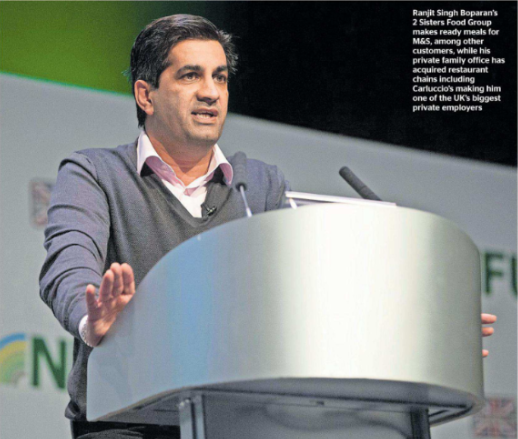
Ranjit Singh Boparan is into more than poultry now, but still focuses on his ‘brilliant basics’, Richard Fletcher writes
Ranjit Singh Boparan

Ranjit Singh Boparan is standing in the middle of one of the food aisles in the M&S store in the Birmingham Bullring.

He has grabbed a pack of M&S Collection 8 Hours Slow Cooked Black Dal off the shelf. “There is a lot of debate about homemade versus shop curry.

This matches homemade,” he boasts as he waves the packet in the air.

Boparan was nicknamed the “Chicken King” in the 2000s, but a few minutes in the food aisle of M&S reveals the true breadth of his 2 Sisters Food Group today. The media, which Boparan has usually shunned throughout his career, will have to find a new sobriquet.

Pizzas, produced in a custom-built, 12-metre, £6.6 million wood fired oven in Nottingham, hot cross buns and Boparan’s favourite sweet and sour chicken, not to mention the entire fresh chicken aisle. It is easier to find the food not supplied by Boparan in M&S than to pick out everything that is.

The black dal is one of the items produced in the 2 Sisters Food Group factory in Rogerstone, Gwent, which after a £7.5 million investment last year now produces 1.7 million ready meals a week exclusively for M&S including Chinese, Thai, Indian and British classics.

When Boparan acquired the factory as part of a wider deal with rival Premier Foods in 2011 it was producing 900,000 meals.

The entrepreneur, who now owns and runs one of the UK’s largest private companies, has a similar tale to tell about the former Fox’s biscuit factory in Elkes, Uttoxeter, which he also acquired in 2011.

The site looked set to close in 2021 until Boparan persuaded Stuart Machin, M&S’s chief executive, and Alex Freudmann, head of M&S food, to partner with him the following year to produce a new range of own-label biscuits while on a tour of the factory.

“It is up to M&S to push us and us to push M&S,” says Boparan, who insists on describing M&S as a partner, rather than a customer.

This is very different from the frozen poultry cutting operation that Boparan, who left school at 16 to become a butcher, founded in West Bromwich in 1993. He has since built a family fortune of more than £1 billion, according to The Sunday Times Rich List.

The 2 Sisters group now employs more than 15,000 people across 24 sites in the UK and Europe. Other customers include Aldi, Asda, Co-op, KFC, Lidl, Morrison’s, Sainsbury’s, Tesco and Waitrose. Turnover topped £3 billion in 2025 and operating profit rose to £101.3 million.

The family’s private office business employs a further 10,000, many of them in hatcheries, feed mills and farms as well as restaurants.

Ten years after a string of acquisitions that transformed 2 Sisters — but also took it to the brink of collapse as interest rates rose and lenders lost confidence — Boparan is laying out a plan to invest more than £1.75 billion in the business. He has dubbed the plan “NextGen”.

“We spent £2 billion on acquisitions in the last 15 years, now we are going to spend £1.75 billion on investment,” he explained.

The plan is driven by Boparan’s belief that the food system isn’t working for people or the planet.

“The next generation of consumers will be more savvy about what they eat, where it comes from, how it’s made and how it was treated.”

On welfare, 2 Sisters birds already have 20 per cent more space and the group is on track to be the biggest provider of higher-welfare poultry in the UK within the next two years.

Having developed a new diet for chickens, which replaces about 20 per cent of the usual South American soya feed with UK-grown peas and beans, Boparan is confident that the group will be able to claim early next year that its chickens are raised on a diet that does not cause deforestation (and in the process support UK farmers).

He is also investing in automation. A new £100 million factory in Coupar Angus, Perthshire, will have capacity to process 1.4 million birds a week thanks to a state of the art food processing fa- cility that incorporates AI and robotics.

That is almost double the capacity of the existing factory.

This confidence is a far cry from 2018, when ratings agency Moody’s downgraded the company’s debt into junk territory. The group’s debt traded for as little as 50p in the pound at the time.

Leverage was then more than seven times earnings. By the end of this year it will fall below two and debt now trades at a premium, 105p in the pound.

The acquisition spree began with a deal to buy Northern Foods in January 2011. “It was badly run, sleepy and corporate, but it had good products and a great customer in M&S,” says Boparan.

“It had forgotten about colleagues and forgotten about its customers.”

Later that year he bought RF Brookes, a chilled food and bakery business, from Premier Foods. Two years later came Vion’s UK poultry and red meat businesses, and in 2016 a deal to buy Bernard Matthews.

So did he do one too many deals? Was the group over indebted? “When you buy a broken business it takes you three years to turn it around. I bought four consecutively,” he says.

“But you can’t time when a business is going to come up for sale. Did I buy more than I could chew? I don’t know. We’ve got through.”

“Some days were pretty tough days,” he concedes. But he quickly adds: “I don’t do regrets, because it just eats you up.”

Boparan would like to be recognised as a turnaround specialist rather than a dealmaker. He takes pride in the number of jobs, 15,000, that he believes he has saved. And he stresses that all of the acquisitions fitted into a longer term plan for the group. Buy, fix, sell and reduce debt, is the mantra. “Eighty five per cent of what I bought have all been turnarounds, in some shape or form,” he said.

And as the business has grown he insists that his management style has changed. “I’ve learnt to stand on the sideline and manage the team.”

It is an impressive team that includes Trevor Strain, the former finance director of Morrisons, along with former senior executives from M&S, Tesco and Sainsbury. “I say, it’s your business, you run it. I’m here to challenge it and support it. But if you get into trouble ... I’m available. Come and ask me and I’ll help you if I can or I’ll get someone who hopefully knows.”

His longstanding chief of staff, who has worked with Boparan since 1997, is charged with making sure his diary includes at least ten hours a week of thinking time and he no longer visits factories every week. “I’ve stopped doing that ... They know you are coming and you get the red carpet. They will waste a day preparing. I really don’t want that.”

Richard Pennycook, the former chief executive of the Co-op, chairs the 2 Sisters holding business. “You have an entrepreneur sitting at the top with a chairman who tries to keep me in order,” says Boparan.

So what is his advice to entrepreneurs starting out now? “Think big, act small and protect your reputation.”

But the key to the group’s success, argues Boparan, is what he describes as the “brilliant basics”. “Brilliant basics are boring. But boring is good. Keep doing it every day. Every hour.

“Everybody wants to do someone else’s job. But they don’t want to do their own. Do your brilliant basics. Once you’ve done your brilliant basics you can do other things.”

So at 59, how much longer will he keep doing his brilliant and boring basics? “The day I get out of bed in the morning and I don’t want to go to work. I will stop. I enjoy what I do. It is a bit like you’re blessed. It’s a bit like a professional athlete who can continue doing what they do and get paid for it.”

Friday, October 24, 2025

ZZ25060 Google invests in THG V01 241025

 Google backs Ingenuity 

NEWS IN BRIEF

Google has invested in the Ingenuity platform spun off by THG in a deal reportedly valuing the business at $1 billion. The internet giant has invested through an instrument that could be converted into equity stake in the ecommerce platform, according to Sky News. Ingenuity supports the online operations of retailers including Holland & Barrett, The Range and L’Oréal. Its demerger has left THG holding the beauty and nutrition business behind the brands MyProtein and Cult Beauty. THG, which was co-founded by Matt Moulding in 2004, pressed ahead with the demerger after a turbulent period as a public company.

ZZ25059 Satellite Developments V01 241025

 European satellite alliance to take on might of Musk


Tom Saunders 

Airbus, Leonardo and Thales have agreed to merge their satellite operations to create a European joint venture to compete with Elon Musk’s SpaceX.

The three aerospace companies have been in talks for months to form a single company that will employ 25,000 people with annual revenues of €6.5 billion, based on 2024 figures.

The venture is expected to become operational as early as 2027 and draws inspiration from the successful MBDA tie-up, which involved BAE Systems, Leonardo and Airbus combining to design and manufacture missiles.

Airbus will own 35 per cent, while Leonardo and Thales will each take 32.5 per cent stakes. The business will be based in Toulouse in France.

The trio said this structure would deliver savings amounting to “mid-tripledigit millions” of euros in operating income five years after closing. Each home country will keep its existing capabilities, with no site closures planned. Executives said the decision was made in response to the disruption in the satellite sector made by the likes of SpaceX, as well as a big increase in government spending on space, particularly by the United States and China.

The shift from satellites in geostationary orbit, 22,250 miles above Earth, an area where Europe has led, to lowearth orbit, 100 to 1,200 miles above Earth, which has been championed by SpaceX’s Starlink among others, has been another driver behind the merger.

Europe has struggled to compete in the low-earth orbit sector. Both Airbus and Thales Alenia Space, a joint venture by Thales and Leonardo that makes satellites and related equipment, have had to restructure their space businesses, with heavy job losses.

OneWeb, one of Europe’s main competitors to Starlink, has seen its revenues rise over the past year, but Eutelsat, its French owner, has struggled to realise value from the service.

A spokesman for Airbus said: “If you really want to grow at the rate that we see the opportunity for, we think we can achieve much more by scaling and collaborating across Europe, more formally than we do currently.”

The new company will develop technologies and solutions for space infrastructure and services. Launch operations into space, an area in which Europe struggles to compete with the US, will not be part of the effort.

Shares in Leonardo rose by €0.84, or 1.7 per cent, to €51.34 in Milan; in Paris Thales was up by €1.50, or 0.6 per cent, to €260.70, and Airbus rose by €1.45, or 0.7 per cent, to €207.25.

Tuesday, October 21, 2025

ZZ25058 William Hague on Innovation V01 211025

 William Hague’s article in The Times on the 21/10/25. Impressive insight and rightly identifies the need to invest in and focus up on innovation for the UK to succeed. 

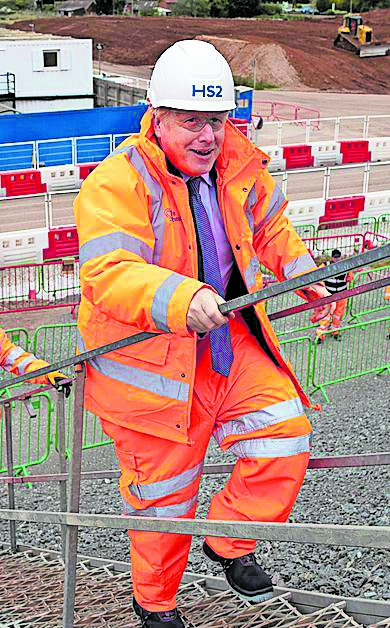
Boris Johnson’s support for HS2 would have been better directed at research

In all the fuss about the Nobel peace prize and whether it would be awarded to President Trump, you might not have noticed last week’s announcement of the Nobel prize for economics. It is an important prize, since it highlights vital discoveries about how economies work. Without such understanding, living standards go backwards and governments fall.

Just as Labour MPs know that their entire fate will probably rest on whether Rachel Reeves can get her budget right next month, so almost everything in politics rests on good economics.

This year the prize has gone to three economists who have demonstrated how sustained economic growth is driven by innovation. One of them, Joel Mokyr, has shown why the British economy stagnated for 400 years up to the 18th century, despite many inventions taking place, and then took off dramatically in the Industrial Revolution after modern science emerged and new technologies were invented at the same time. Sustained growth, he has shown, depends on science and technology evolving together, a high level of mechanical competence to make the most of them, and a society open to disruptive change.

The other two winners, Philippe Aghion and Peter Howitt, also showed how innovation is the key driver of growth, through a process of “creative destruction” of established companies by new products and processes. While the work of all three economists is about how innovation unfolds, it is clear from their conclusions that such innovation is the main and overwhelmingly important determinant of whether we live in a growing or a stagnating economy.

Isn’t this obvious, you might think? Isn’t it clear that US growth this century has resulted from a mass of innovation in Silicon Valley, not from the average shop or factory in America? Don’t all governments say they favour innovation? Well yes, it should be obvious, and yes, they do all say that. But what they then do is entirely different. In Britain and the rest of Europe, while governments have many initiatives that support innovation, much of their activity fails to give it sufficient priority and most of their policies actively stifle it. That is why they are stuck in stagnation and running out of money.

Ministers continue to believe that building infrastructure and spending more money creates growth. But if innovation is the key driver of growth, they are wrong. Take HS2 as an example. It will cost, ultimately, over £100 billion. If it had been a well-managed project that actually reached most of the intended places, we could expect that people could travel more quickly and move more easily for work. That is assumed to be growth because, short-term, it is more activity. But in reality, all we will have done is spent scarce money and allowed a lot of running around within a stagnating economy.

£40m innovation fund is equal to three hours’ debt interest payments

Now imagine that we truly understood that innovation drives growth. Think what would have happened if we had taken that £100 billion and spent it on much more funding for Aria (the advanced research agency), paying higher salaries to scientific researchers, slashing capital gains tax for young entrepreneurs, training far more people with technical skills, giving visas free of charge to the cleverest people working in AI, and supporting firms developing new types of batteries or rare earths processing who cannot compete against Chinese subsidies.

Would we have a better chance of a growing economy if we had thrown our resources at such things? Clearly, successive governments have not thought so. But according to the logic of the Nobel prize winners, yes, we would. I think they are right.

Ministers like to “build, build, build”, because new towns and infrastructure are things you can touch, point at and for which they can claim credit. The trouble with putting effort into new ideas is that they are uncertain, you can’t see them, they are risky and the National Audit Office finds it hard to measure them. Yet the only hope of growth is to encourage people to “think, think, think”.

I never want to be unfair to the government. It has rightly embarked on several initiatives to encourage innovation: a new global talent fund to attract researchers, a “concierge” service to help finance firms locate in Britain, reform of pension schemes to promote investment in UK firms, longer-term ten-year budgets for research funding, a new health data research service and more such items.

The Treasury is now frantically looking for new ideas, such as cheaper patents benefiting start-up firms, to persuade the Office for Budget Responsibility to soften the coming downgrade of future growth.

But if it is true that innovation is the critical factor in future prosperity, then it needs to be a far higher priority, not to be inhibited by the rest of government policy and not thought of only at the last minute before a budget.

A good example of government support for innovation is the £40 million announced in the last budget to support university spin-outs — a prime source of future growth. Yet the initial tranche of this funding was heavily oversubscribed, which suggests many ideas need more support. And £40 million is what we spend on debt interest every three hours. It is the total spent on health and disability benefits every six hours — a rapidly increasing sum that ministers have failed to reform.

This is a hopeless sense of priorities, yet it is only an innovative economy that will be able to afford the vast benefit and pension bills of future decades.

Ministers often support innovation with one hand and frustrate it with another. Monday’s pages of The Times revealed how the vital work to develop SMRs (small modular nuclear reactors) had been delayed and made more expensive in an excessively bureaucratic process.

Firms bidding to supply the new technology have been asked to demonstrate the “social value” of their supply chains, including employment of refugees. Such rules have contributed to a two-year process while other countries forge ahead. Real social value would come from having a growing economy, with cheaper energy, in which everyone has a better chance of finding work.

While the Nobel prize is the clearest evidence yet that innovation decides our future, ministers, government departments and regulators are light years away from behaving as if that is true. We are a country of extraordinary talent with endless ideas. Yet many of those ideas are flattened by the grinding, dull uniformity of regulation; or cannot find the capital as wealthy investors are pushed abroad and public money for growth goes overwhelmingly into infrastructure instead.

Listen to many economists and political leaders and you might think growth comes from government spending, or entirely depends on interest rates, small tax changes, stability or consumer confidence.

These things do matter, day to day.

But to grow sustainably we need the freedom to have new ideas and implement them. Literally everything will depend on it.

Wednesday, October 15, 2025

ZZ25057 AI update newsletter. V01 151025

 Copied from a Newsletter from www.decodingdatascience.com

This week was all about infrastructure and alliances: enterprise platforms got more centralized, compute supply chains diversified beyond a single vendor, and new tooling lowered the operational burden of fine-tuning. For builders and startups, the signal is clear—optimize for governance, hardware agility (CUDA + ROCm), and faster data/agent iteration.

IBM × Anthropic (enterprise IDE + governance):

IBM will embed Anthropic’s Claude across parts of its enterprise software stack, starting with an AI-first IDE aimed at upgrades, migrations, and refactoring—framed with security/governance guidance for production AI agents. Early previews report significant developer productivity gains and a push to make agents a first-class part of the SDLC.

Google launches Gemini Enterprise (central AI interface):

Google introduced a company-wide conversational layer with a no/low-code workbench to build agents that can safely access data across Workspace, Microsoft 365, Salesforce, SAP, and more—shifting focus from one-off pilots to operating fleets of task-specific agents with access control and observability. 

OpenAI × AMD (6 GW compute + equity warrants)

OpenAI signed a multi-year deal to deploy 6 GW of AMD Instinct MI450 GPUs (first 1 GW in 2H 2026) and received warrants to buy up to ~10% of AMD upon milestones—diversifying beyond NVIDIA and signaling falling long-run compute costs; plan for ROCm and heterogeneous clusters.

Tuesday, October 14, 2025

ZZ25056 Wayve an AI Start Up. V01 141025

 Wayve aims to wheel in Microsoft


Katie Prescott - Technology Business Editor

Wayve, one of the UK’s top artificial intelligence start-ups, is in early discussions with Microsoft and SoftBank to raise up to $2 billion of new funding.

In a sign of the deal-making frenzy around leading AI businesses, the London-based driverless car company would be valued at $8 billion if the investment went ahead, according to a report in the Financial Times.

Wayve was founded in a garage in 2017 by Cambridge University PhD students Alex Kendall and Amar Shah.

The pair, who researched machine learning, computer vision and robotics, wanted to explore a different approach to developing driverless cars.

Rather than feeding rules into computers to account for every driving eventuality, Wayve’s technology “teaches” autonomous vehicles how to drive using videos and data from real life collected by partners including Asda and Ocado. This means vehicles can navigate any environment and are more responsive to unexpected incidents such as another vehicle swerving.

Last year SoftBank, the Japanese investment company, led a $1 billion funding round for Wayve, along with Nvidia and Microsoft, to help develop the start-up’s AI software, which can make any vehicle hands-free.

Nvidia, the American AI company, ploughed in a further $500 million in September as part of a series of investments made by Jensen Huang, its chief executive, in some of London’s most successful AI companies.

Other investors over the years have included Ilya Sutskever, the OpenAI co-founder, and Yann LeCun, the chief AI scientist at Meta. Since SoftBank’s 2024 round, Wayve has expanded around the world and employs 800 people, with offices in six countries.

It has signed a deal with Nissan to put its software into the carmaker’s vehicles by 2027, and has partnered with Uber with a view to deploying its tech across its ride-hailing network. They will be trialled in the UK next spring.

It is hoped driverless cars will cut the number of road accidents by removing human error, drunk driving and road rage. Wayve declined to comment.

ZZ25055 Oracle’s Oxford University Research Investment V01 141025

 Ellison to pump cash into Oxford

Oracle tycoon commits to science park extension

Alex Ralph - Chief Business Correspondent

Larry Ellison, one of the world’s richest tycoons, has agreed to invest a further £890 million to expand his technology institute in Oxford amid recent concerns about its trajectory.

The founder and chairman of Oracle, the American software giant, has committed to a significant extension of the Oxford Science Park, with plans to now build a complex covering 2 million sq ft and accommodating up to 7,000 people.

The deeper investment in the Norman Foster-designed campus marks a near six-fold expansion of plans unveiled two years ago to cover 300,000 sq ft by 2027.

Ellison, 81, has vowed to concentrate his resources on the institute to combat some of humanity’s most “challenging and enduring problems” such as health, food security and climate change.

The government has made life sciences and technology key parts of its industrial strategy to grow the economy, and Ellison and his senior leadership have been working closely with Sir Tony Blair, a friend of the tycoon, as well as ministers and officials.

In an exclusive interview at the institute’s St James’s Square office, Santa Ono, appointed global president of the Ellison Institute of Technology in August, told The Times it was “the most exciting investment in research and innovation anywhere in the world”.

Ono, a former head of the universities of British Columbia and Michigan, said the economic benefit would eventually amount to billions of pounds.

“A research enterprise of this size with the spin-off companies, the licensing deals or the exits of start-up companies, they’re in the billions. We anticipate there’ll be multiple spin-offs in the not too distant future. And so if you aggregate that together with all the activity of thousands of people who are living and working there, it’s usually billions.”

The renewed commitment follows the emergence of internal problems and upheaval in senior leadership this year. Concerns raised last month included a “toxic” culture; a “cavalier attitude” of hiring and quickly letting staff go; frustrations from scientists over “cumbersome” HR and building delays; and bullying allegations.

There have also been fears that the institute’s fundamental vision had shifted away from commercialising science and uncertainty over the longterm financing of the institute, with no endowment believed to be in place.

However, Ono, 62, and Lisa Flashner, the US chief operating officer, said Ellison remained committed to having a commercial impact soon and played down internal concerns. “Larry has succeeded over the years because he expects people to be focused and dedicated and to deliver … I think that that expectation is appropriate,” Ono said.

Flashner, who has relocated to Oxford and was previously chief operating officer of the Ellison Medical Institute in Los Angeles, said: “We’ve been growing very rapidly in the last 18 months. It’s a very short time. It’s natural to have some people who love the place and some [who find change hard].


A computer-generated image of the Ellison Institute of Technology in Oxford, set for completion in 2027.

In a luxurious townhouse in St James’s Square in London, the leaders of Larry Ellison’s technology institute are accelerating plans for a new multibillionpound campus in Oxford.

Sitting at the foot of the fourth-floor boardroom table in front of screens projecting Norman Foster-designed architectural images, Santa Ono, the newly appointed global president of the Ellison Institute of Technology, has flown in to oversee a major expansion of the “vision” of the world’s secondrichest person.

Two years ago Ellison, 81, founder and chairman of Oracle, the US technology giant, launched his mission to solve some of humanity’s most “challenging and enduring problems” — spanning health, food security and climate change — through a new institute at the Oxford Science Park in the south of the city, to be completed in 2027.

Amid recent, abrupt changes in senior leadership and concerns about the culture, direction and future of the institute, the billionaire tycoon now plans to invest another £890 million in the Oxford campus to build a laboratories and office complex covering 2 million sq ft and employing up to 7,000 people.

Ono, a former head of the universities of British Columbia and Michigan who was appointed in August, tells The Times: “I’ve seen nothing like it anywhere in the world.

“He’s putting together, primarily in Oxford, a set of world-class scientists that are supported by an extraordinary infrastructure of what ultimately will be unparalleled strengths in robotics, artificial intelligence and machine learning.”

Following the surprise departure of Professor Sir John Bell — former regius professor of medicine at Oxford — as president of the institute last month, there have been concerns that the institute’s fundamental vision has shifted away from commercialising science towards being more of a traditional research institute.

Ono, speaking alongside Lisa Flashner, the institute’s American chief operating officer, insists, though, there has been “no backpedalling”, and that having “impact” through commercialising science “will always be the founding principle. It’ll be integrated into the collective DNA of everyone recruited to the institute.”

He adds: “We anticipate multiple spin-offs in the not too distant future.”

The plans also include co-investing and collaborating with other companies, with profits invested back into the institute.

Current investments include becoming the largest shareholder in Oxford Nanopore Technologies, the FTSE 250 company that is a neighbour at the science park, through EIT Oxford Holdings, a California-based parent company.

Professor Hagan Bayley, a founder of Oxford Nanopore, is joining the institute as a principal scientist.

One ambition is to address the “valley of death”, where start-ups fail or progress slowly because of a lack of scale-up capital. The funding gap has forced many of the UK’s most promising technologies and ventures to turn to the United States for finance and growth.

The institute signed a “long-term strategic alliance” with the University of Oxford last December but also plans to collaborate with other UK institutions, including across the “Oxford- Cambridge corridor” and in London, via its St James’s office — areas that combine to form the so-called Golden Triangle.

“I used to be a professor at University College London, and the postgraduate medical institutions in the London universities — UCL, Imperial, King’s — are world-class,” Ono says.

As part of its hiring spree it is seeking to attract the brightest globally, including from the US, where the Trump administration is making sweeping cuts to federal research budgets.

In Oxford, the institute is conscious of not “taking away” from the univers- ity, but of aiming to create a “synergistic relationship”.

Ono says: “Some of the scientists who are coming in are at or near retirement age at the university and so it makes sense.

“It’s a win-win to keep them in the ecosystem, to invest in them, to continue investing in their science, which is still continuing to pay dividends, and they’re still adjacent to Oxford University.”

Similarly, the institute plans to work with Oxford Science Enterprises (OSE), an investment company that is already building ventures from promising technology and science from the university.

“You need lots of different players in this ecosystem to make it successful,” says Flashner, who spent 15 years in the same role at the Ellison Medical Institute in Los Angeles and has a background in venture capital. “I do think a lot of Silicon Valley.

“You need spin-outs, you need multiple entrepreneurs, you need venture and private [capital] across the spectrum. And so we look at OSE as a really great partner to us.”

As part of the institute’s plans to create creative hubs, Ellison is also investing in refurbishing the grade II listed Eagle and Child pub, which was purchased from St John’s College. Planning permission and listed building consent have now been granted for the restoration, which is being led by architects Foster + Partners, alongside the firm’s work at the campus.

Ono says: “You need to have hubs. Some of the greatest ideas come from just ad hoc, spontaneous conversations, bringing people together from different perspectives, and an idea germinates.”

As part of its effort to develop the next generation of innovators and leaders, the first cohort of the Ellison scholars programme enjoyed a recent “welcome” retreat at Elcot Park in west Berkshire. They were met by Sir Tony Blair, a friend of Ellison and among a “faculty of fellows” at the institute.

The “long-term strategy” is to work closely with the Tony Blair Institute (TBI).

Flashner says: “We’re going to need to look globally and TBI has such great relationships around the world. So you can see that as an important piece of what we’re doing.”

The institute has been engaging with government officials and ministers. Further meetings are planned in November.

Lord Vallance of Balham, the science minister and a former senior executive at GSK, one of Britain’s two big pharma companies, has been “very supportive”, Flashner adds.

The institute has co-founded a campaign to reopen the Cowley branch line to rail passengers, to link the city centre to the campus, and also to create a new direct service to London Marylebone.

The campaign groups have committed almost £25 million in funding for the project and are lobbying for government support.

The infrastructure, should it receive authorisation from Westminster, is likely to take many years.

Among the other concerns of current and former staff has been the long-term financing commitment of the institute, with no endowment believed to be in place.

Both Ono and Flashner seek to reassure the doubters.

“This is important to him [Ellison]. This is his legacy. This is something that he wants to survive long beyond all of us are around, for millennia.”