Ellison to pump cash into Oxford
Larry Ellison, one of the world’s richest tycoons, has agreed to invest a further £890 million to expand his technology institute in Oxford amid recent concerns about its trajectory.
The founder and chairman of Oracle, the American software giant, has committed to a significant extension of the Oxford Science Park, with plans to now build a complex covering 2 million sq ft and accommodating up to 7,000 people.
The deeper investment in the Norman Foster-designed campus marks a near six-fold expansion of plans unveiled two years ago to cover 300,000 sq ft by 2027.
Ellison, 81, has vowed to concentrate his resources on the institute to combat some of humanity’s most “challenging and enduring problems” such as health, food security and climate change.
The government has made life sciences and technology key parts of its industrial strategy to grow the economy, and Ellison and his senior leadership have been working closely with Sir Tony Blair, a friend of the tycoon, as well as ministers and officials.
In an exclusive interview at the institute’s St James’s Square office, Santa Ono, appointed global president of the Ellison Institute of Technology in August, told The Times it was “the most exciting investment in research and innovation anywhere in the world”.
Ono, a former head of the universities of British Columbia and Michigan, said the economic benefit would eventually amount to billions of pounds.
“A research enterprise of this size with the spin-off companies, the licensing deals or the exits of start-up companies, they’re in the billions. We anticipate there’ll be multiple spin-offs in the not too distant future. And so if you aggregate that together with all the activity of thousands of people who are living and working there, it’s usually billions.”
The renewed commitment follows the emergence of internal problems and upheaval in senior leadership this year. Concerns raised last month included a “toxic” culture; a “cavalier attitude” of hiring and quickly letting staff go; frustrations from scientists over “cumbersome” HR and building delays; and bullying allegations.
There have also been fears that the institute’s fundamental vision had shifted away from commercialising science and uncertainty over the longterm financing of the institute, with no endowment believed to be in place.
However, Ono, 62, and Lisa Flashner, the US chief operating officer, said Ellison remained committed to having a commercial impact soon and played down internal concerns. “Larry has succeeded over the years because he expects people to be focused and dedicated and to deliver … I think that that expectation is appropriate,” Ono said.
Flashner, who has relocated to Oxford and was previously chief operating officer of the Ellison Medical Institute in Los Angeles, said: “We’ve been growing very rapidly in the last 18 months. It’s a very short time. It’s natural to have some people who love the place and some [who find change hard].
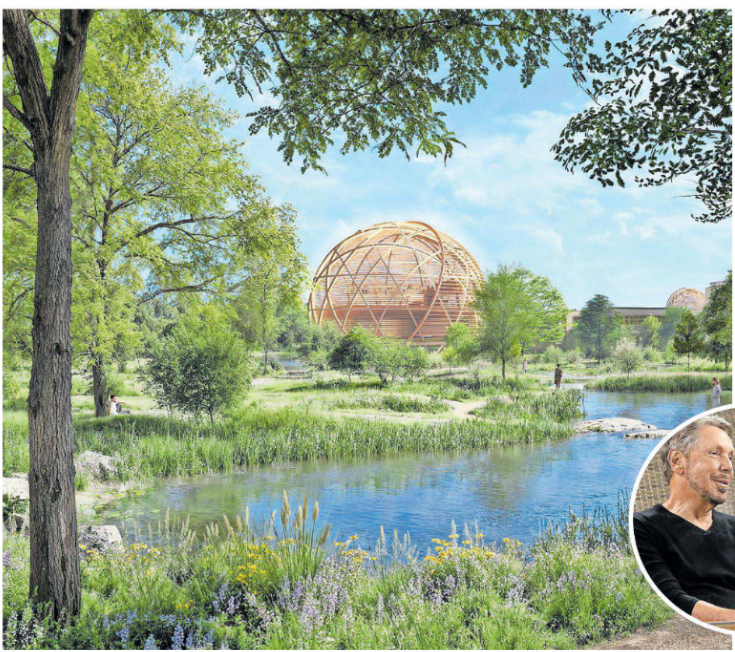
In a luxurious townhouse in St James’s Square in London, the leaders of Larry Ellison’s technology institute are accelerating plans for a new multibillionpound campus in Oxford.
Sitting at the foot of the fourth-floor boardroom table in front of screens projecting Norman Foster-designed architectural images, Santa Ono, the newly appointed global president of the Ellison Institute of Technology, has flown in to oversee a major expansion of the “vision” of the world’s secondrichest person.
Two years ago Ellison, 81, founder and chairman of Oracle, the US technology giant, launched his mission to solve some of humanity’s most “challenging and enduring problems” — spanning health, food security and climate change — through a new institute at the Oxford Science Park in the south of the city, to be completed in 2027.
Amid recent, abrupt changes in senior leadership and concerns about the culture, direction and future of the institute, the billionaire tycoon now plans to invest another £890 million in the Oxford campus to build a laboratories and office complex covering 2 million sq ft and employing up to 7,000 people.
Ono, a former head of the universities of British Columbia and Michigan who was appointed in August, tells The Times: “I’ve seen nothing like it anywhere in the world.
“He’s putting together, primarily in Oxford, a set of world-class scientists that are supported by an extraordinary infrastructure of what ultimately will be unparalleled strengths in robotics, artificial intelligence and machine learning.”
Following the surprise departure of Professor Sir John Bell — former regius professor of medicine at Oxford — as president of the institute last month, there have been concerns that the institute’s fundamental vision has shifted away from commercialising science towards being more of a traditional research institute.
Ono, speaking alongside Lisa Flashner, the institute’s American chief operating officer, insists, though, there has been “no backpedalling”, and that having “impact” through commercialising science “will always be the founding principle. It’ll be integrated into the collective DNA of everyone recruited to the institute.”
He adds: “We anticipate multiple spin-offs in the not too distant future.”
The plans also include co-investing and collaborating with other companies, with profits invested back into the institute.
Current investments include becoming the largest shareholder in Oxford Nanopore Technologies, the FTSE 250 company that is a neighbour at the science park, through EIT Oxford Holdings, a California-based parent company.
Professor Hagan Bayley, a founder of Oxford Nanopore, is joining the institute as a principal scientist.
One ambition is to address the “valley of death”, where start-ups fail or progress slowly because of a lack of scale-up capital. The funding gap has forced many of the UK’s most promising technologies and ventures to turn to the United States for finance and growth.
The institute signed a “long-term strategic alliance” with the University of Oxford last December but also plans to collaborate with other UK institutions, including across the “Oxford- Cambridge corridor” and in London, via its St James’s office — areas that combine to form the so-called Golden Triangle.
“I used to be a professor at University College London, and the postgraduate medical institutions in the London universities — UCL, Imperial, King’s — are world-class,” Ono says.
As part of its hiring spree it is seeking to attract the brightest globally, including from the US, where the Trump administration is making sweeping cuts to federal research budgets.
In Oxford, the institute is conscious of not “taking away” from the univers- ity, but of aiming to create a “synergistic relationship”.
Ono says: “Some of the scientists who are coming in are at or near retirement age at the university and so it makes sense.
“It’s a win-win to keep them in the ecosystem, to invest in them, to continue investing in their science, which is still continuing to pay dividends, and they’re still adjacent to Oxford University.”
Similarly, the institute plans to work with Oxford Science Enterprises (OSE), an investment company that is already building ventures from promising technology and science from the university.
“You need lots of different players in this ecosystem to make it successful,” says Flashner, who spent 15 years in the same role at the Ellison Medical Institute in Los Angeles and has a background in venture capital. “I do think a lot of Silicon Valley.
“You need spin-outs, you need multiple entrepreneurs, you need venture and private [capital] across the spectrum. And so we look at OSE as a really great partner to us.”
As part of the institute’s plans to create creative hubs, Ellison is also investing in refurbishing the grade II listed Eagle and Child pub, which was purchased from St John’s College. Planning permission and listed building consent have now been granted for the restoration, which is being led by architects Foster + Partners, alongside the firm’s work at the campus.
Ono says: “You need to have hubs. Some of the greatest ideas come from just ad hoc, spontaneous conversations, bringing people together from different perspectives, and an idea germinates.”
As part of its effort to develop the next generation of innovators and leaders, the first cohort of the Ellison scholars programme enjoyed a recent “welcome” retreat at Elcot Park in west Berkshire. They were met by Sir Tony Blair, a friend of Ellison and among a “faculty of fellows” at the institute.
The “long-term strategy” is to work closely with the Tony Blair Institute (TBI).
Flashner says: “We’re going to need to look globally and TBI has such great relationships around the world. So you can see that as an important piece of what we’re doing.”
The institute has been engaging with government officials and ministers. Further meetings are planned in November.
Lord Vallance of Balham, the science minister and a former senior executive at GSK, one of Britain’s two big pharma companies, has been “very supportive”, Flashner adds.
The institute has co-founded a campaign to reopen the Cowley branch line to rail passengers, to link the city centre to the campus, and also to create a new direct service to London Marylebone.
The campaign groups have committed almost £25 million in funding for the project and are lobbying for government support.
The infrastructure, should it receive authorisation from Westminster, is likely to take many years.
Among the other concerns of current and former staff has been the long-term financing commitment of the institute, with no endowment believed to be in place.
Both Ono and Flashner seek to reassure the doubters.
“This is important to him [Ellison]. This is his legacy. This is something that he wants to survive long beyond all of us are around, for millennia.”

No comments:
Post a Comment