ORACLE CORP
Employees
160,000
Registered
customers 5m
Oracle Corp is the technology giant that until last week everyone rather forgot about. The Texas-based computer software company, while a Goliath, laboured in the shadow of even bigger and more talked-about beasts like Apple, Amazon, Alphabet and others.
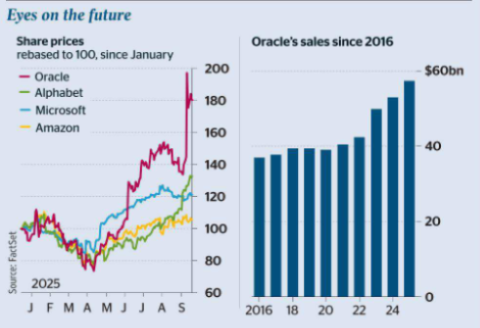
That changed when the company outlined spectacular Septemberquarter numbers which demonstrated how far it had come and how far it may yet go in the battle of the so-called “hyperscalers”, the providers of data centres on which the AI revolution depends.
Oracle shares surged by as much as 43 per cent on the day and the company founder Larry Ellison was briefly declared to be the richest person on earth, thanks to his 41 per cent stake. (Elon Musk has since reclaimed the crown).
Oracle, founded in 1977, is older than many of its tech rivals and was for years seen as duller. It began life as a provider of packaged computer software to businesses and still operates in that area as well as in hardware. Revenues have built steadily over the years.
Its sudden appeal today lies in its extraordinary success in bagging orders from the AI princes: companies like OpenAI, the creator of ChatGPT, and Musk’s xAI. They need the data-centre capacity to store and crunch information and Oracle is happy to provide it.
The company reported an astonishing $455 billion in what it calls “remaining performance obligations” or RPOs, a proxy for expected future revenue, which was up 359 per cent on a year and more than double what Wall Street analysts had been pencilling in.
Safra Catz, chief executive, went on to say she expected to bag much more business shortly and that the RPO figure would exceed $500 billion over the next few months. That kind of reliable “sticky” income gushing in years into the future is what investors love.
Revenue from its hyperscaler partners Amazon, Microsoft and Alphabet-owned Google grew by a breathtaking 1,500 per cent in the quarter. There could be more to come after Ellison pledged to lift data centres from the current 34 to 71.
Oracle is on a roll and now weighs in at more than $850 billion, which is two thirds of a Tesla. For investors, there is plenty that may yet lead to disappointment, however.
The first is its spicy valuation. The shares now trade on 44.6 times expected profits for the year to May 2026. That drops to a p/e multiple of about 30 times by 2028 if all goes well, but at these stratospheric levels Oracle remains vulnerable.
One big unknown is the competitive response of the other hyperscalers, who are customers but also rivals. Amazon, Microsoft and Alphabet have more experience and clout and could respond aggressively if they see their turf threatened.
Cloud infrastructure is fashionable now but it is comparatively lowmargin and highly capital-intensive, not generally the features of a sector that produces sustainably supernormal profits. Oracle’s offering has some features that distinguish it from the competition but the jury is out on how this market develops.
Another potential worry is the cost of building out the planned network of data centres. While many countries are rolling out the red carpet just now, the cost in fancy chips, in energy and water and in regulatory goodwill is uncertain.
One final concern is key-man risk. This is still a company completely dominated by Ellison, 81, who is both executive chairman and chief technology officer. It is his energy and drive that have of course propelled the group to its success so far, but this maverick quality and determination to win at all costs can be a two-edged sword. Outside shareholders have been allegedly disadvantaged in the past, as when he sold $900 million of Oracle stock before a profit warning in 2000 which sent the share price tumbling. He later settled accusations of insider dealing by paying $100 million to charity.
His fanatical belief in the profound power of AI is, for now, paying off in spades. “AI is a much bigger deal than the Industrial Revolution, electricity and everything that’s come before,” he said earlier this year.
But the frenzy of excitement in, and dollars committed to, AI will eventually subside.
ADVICE Avoid
WHY Strong company with sticky customers but vulnerable to a sell-off when the AI frenzy subsides

No comments:
Post a Comment