The Times Copyright (080925)
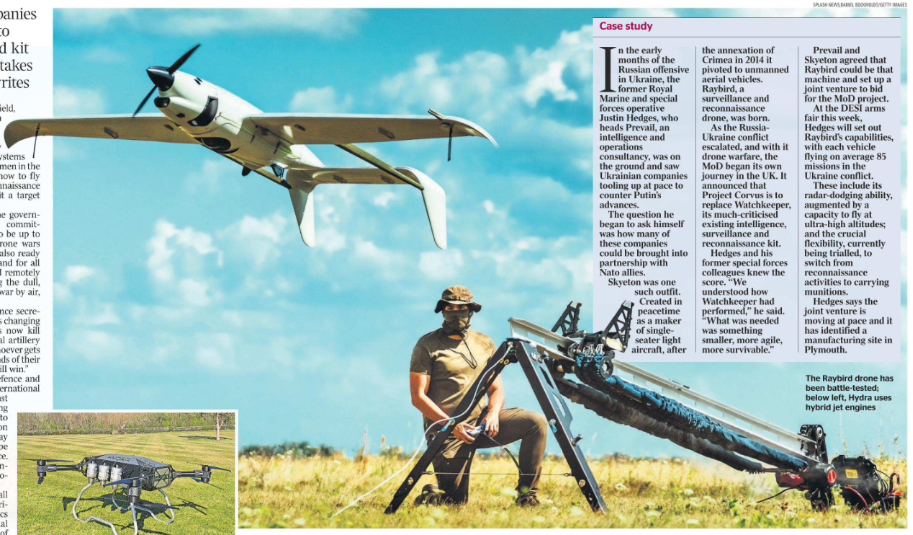
In a corner of a Hampshire field, the lessons from a foreign war are playing out. Soldiers from 2nd Battalion the Parachute Regiment’s newly formed uncrewed aerial systems platoon are training infantrymen in the regular army not only on how to fly drones but to operate reconnaissance missions and, ultimately, hit a target with a suicide drone.
It is one small part of the government’s multibillion-pound commitment for the UK military to be up to scratch for the world of drone wars in Russia and Ukraine, but also ready to meet the emerging demand for all manner of autonomous and remotely controlled equipment doing the dull, dirty or dangerous work of war by air, land or sea.
As John Healey, the defence secretary, has said: “Technology is changing how war is fought. Drones now kill more people than traditional artillery in the war in Ukraine and whoever gets new technology into the hands of their armed forces the quickest will win.”
This week the annual Defence and Security Equipment International (DSEI) arms show in east London takes place. Stepping up to the government’s call to arms, this year the exhibition will showcase a dizzying array of capabilities and wannabe players in the drone space.
Already the sector is demonstrating that this is not a homogenous technology.
Drones are appearing in all shapes and sizes and for myriad applications. In logistics they can be used for the final ten-mile battlefield delivery of munitions or medical supplies; in maritime, for ship-to-ship or ship-to-shore transfers.
They are also used for reconnaissance, intelligence and surveillance; in electronic warfare, to jam the opposition’s communications or bring down missiles or hostile vehicles; and in kinetic warfare — in other words, for blowing things up.
To mention just a few of the firms at DSEI out of the hundreds in Britain that now claim to operate in this area, they include Hydra Drones, based at Royal Wootton Bassett, using hybrid jet engines for heavy-lift drones; Tekever, a Portuguese-British company on board with the RAF flying intelligence missions; Anduril, a US firm promising to build facilities in the UK, specialising in interceptor drones; and Modini, an Italian firm already on the MoD payroll producing “one-way effectors” or suicide drones. While uncrewed or autonomous solutions are increasingly used in all walks of life, including the military, is drone warfare actually the future?
“Looking at Ukraine, we see a ‘droneised’ conflict,” says Robert Tollast, a research fellow at the Royal United Services Institute, a defence think tank.
“Will our next conflict be as ‘droneised’?” The question is worth asking for three reasons, he says. First, the Ukraine-Russia conflict is unique in that Russia may have a large air force but it is outdated, was not at war readiness and lacked trained pilots. The air force of Ukraine was not fit for purpose, but Kyiv did have technologists rapidly pivoting to developing uncrewed aerial vehicles. The second reason is that drone warfare is alien to conventional British military strategy, which is designed around gaining air supremacy with the destructive capabilities of F-35 and Typhoon combat aircraft.
The third is industrialisation. Does Britain have the appetite or the capability to build drones of whatever stripe at volume? “If we go down the Ukraine business model,” Tollast says, “there are industrial implications.”
Andrew Kinniburgh is the director general of Make UK Defence, the military manufacturing arm of the engineering employers’ federation Make UK. The prize, he says, has to be to get away from monopoly or duopoly procurement by the MoD.
The development in the drone sector is all about challenger enterprises delivering innovation — the very antithesis of the too-slow, too-expensive model of dealing with prime contractors who are responsible for an entire project.
“We have to wean ourselves off an outdated model,” Kinniburgh says.
His experience of connecting likeminded businesses in Make UK Defence is that automotive and oil and gas firms are ready to bring manufacturing expertise and capability to the technology disruptors.
Then there is the almost unspoken angle to the drone revolution: space.
Drones can only work with satellite technology and there is a strategic risk if satellite investment does not keep pace. As one leading executive put it: “If satellite capabilities lag behind drone deployment, it could limit global reach and autonomous operation of drones, reduce real-time targeting and surveillance effectiveness, and increase dependency on allied satellite networks, compromising sovereignty.”
And then there are the operational skills. Down at the army’s Bramley Training Area near Basingstoke, Hampshire, trainees are being taught how to fly drone strike missions while avoiding hostile aerial and electronic warfare countermeasures.
Kingsman Kaidyn Hilton of 1st Battalion the Duke of Lancaster’s Regiment told the Forces News website that migrating from simply flying a machine remotely to piloting a suicide drone is a significant step up.
“They are hard to fly because you are fully in control of it whereas a normal drone is basically on autopilot and you’re directing it where to go,” he said.
“It can be disorientating, you need to really concentrate as you’re getting told information about the tactical situation by someone who is outside your bubble.
You’ve got control of a weapon that can hit bigger targets more quickly than the infantry used to be able to do. This is where warfare is going and the skills are very different to what you would expect for an infantry soldier.”

No comments:
Post a Comment